Personal Injury: A Comprehensive Guide to Accidents, Claims, Liability, and Common Issues
Personal injury is one of the broadest areas of civil law and affects millions of people each year. Whenever someone is harmed because of another person’s careless or unsafe behavior, the law—depending on the jurisdiction—may provide a system for evaluating responsibility and determining compensation. Personal injury law is designed to address the consequences of injuries, help people understand their rights, and outline how responsibility is typically assessed after accidents.
This guide provides an in-depth, non-legal-advice overview of what personal injury means, the most common types of claims, how fault is evaluated, what insurance usually covers, and what injured individuals can expect as part of the broader process.
1. What Is Personal Injury?
Personal injury refers to any harm caused to a person’s body, mind, or emotional well-being due to an accident or incident. Unlike property damage, personal injury concerns physical or psychological harm, which can range from minor bruises to catastrophic injuries requiring long-term care.
These cases typically arise when:
-
A person acts carelessly or negligently
-
Someone fails to follow safety rules
-
A dangerous condition leads to injury
-
A defective product harms a consumer
Personal injury disputes are usually resolved through insurance claims, civil settlements, or, in some cases, litigation.
2. How Common Are Personal Injuries? National Overview
Personal injuries occur in virtually every setting—homes, workplaces, roadways, stores, parks, and medical facilities. Some key statistics help illustrate the scope:
-
Over 40 million emergency-room visits each year in the U.S. are related to injuries from accidents.
-
Motor vehicle accidents are a top cause of injury-related deaths and traumatic brain injuries.
-
Slip-and-fall injuries send around 8 million people to emergency care annually.
-
Workplace accidents account for thousands of serious injuries and fatalities each year.
The economic cost of personal injuries—including medical expenses, lost productivity, and related losses—exceeds hundreds of billions of dollars annually, according to federal data.
3. The Foundation of Personal Injury: Negligence
Most personal injury matters revolve around the concept of negligence, a legal principle that determines whether someone failed to act with reasonable care.
3.1 Elements of Negligence
Four core elements are typically required:
-
Duty of Care
A person or entity has a responsibility to act safely or avoid causing harm. For example, drivers must operate vehicles attentively, and property owners must maintain reasonably safe premises. -
Breach of Duty
A breach occurs when someone fails to meet the expected standard of care, such as speeding, ignoring hazards, or producing a defective product. -
Causation
The breach must directly cause the injury. This includes both actual cause (factual connection) and proximate cause (foreseeability questions). -
Damages
The injured person must have measurable harm, such as physical injuries, medical bills, or lost income.
These four elements form the backbone of many personal injury evaluations.
4. The Most Common Types of Personal Injury Cases
Personal injury encompasses many categories. Below are the most frequent types seen across the United States.
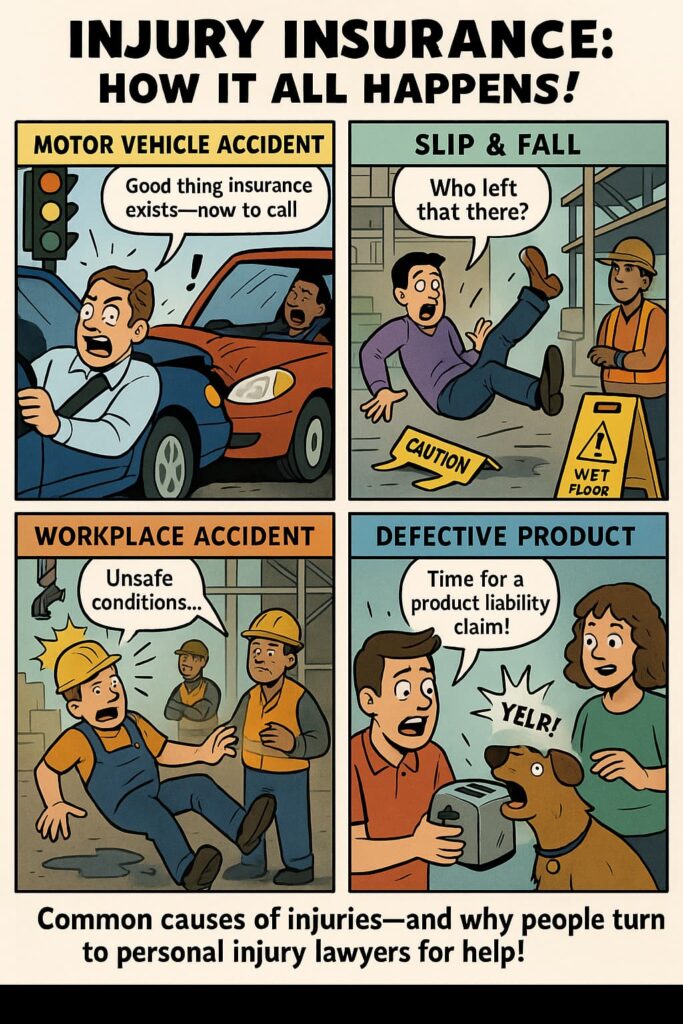
4.1 Motor Vehicle Accidents
These are the most common source of personal injury claims. They include:
-
Car accidents
-
Truck accidents
-
Motorcycle accidents
-
Bus accidents
-
Rideshare incidents
-
Pedestrian and bicycle collisions
Most involve some form of driver error such as speeding, distraction, or failure to obey traffic laws.
4.2 Slip and Fall (Premises Liability)
Property owners, businesses, and landlords may be responsible when unsafe conditions cause injury. Common hazards include:
-
Wet floors
-
Broken handrails
-
Uneven pavement
-
Poor lighting
-
Hidden obstacles
-
Snow and ice accumulation
Premises liability law evaluates whether the owner knew or should have known about the danger.
4.3 Medical Malpractice
Medical negligence occurs when healthcare professionals fail to provide the accepted standard of care, causing harm through:
-
Misdiagnosis or delayed diagnosis
-
Surgical errors
-
Medication errors
-
Birth injuries
-
Communication breakdowns
-
Failure to monitor patients
These cases often require expert medical review and involve complex standards of care.
4.4 Product Liability
Manufacturers, distributors, and retailers may be responsible for injuries caused by defective products. Common categories include:
-
Dangerous pharmaceuticals or medical devices
-
Faulty vehicle components
-
Unsafe consumer products
-
Toxic household chemicals
-
Defective tools or machinery
Product liability may involve theories of negligence, strict liability, or failure to warn.
4.5 Workplace Injuries
Work injuries often fall under workers’ compensation systems. Common workplace accident causes include:
-
Falls
-
Machinery accidents
-
Heavy lifting
-
Repetitive motion injuries
-
Exposure to toxic substances
In some situations, “third-party” claims may arise against manufacturers or outside contractors.
4.6 Dog Bites and Animal Attacks
Laws vary significantly by state and municipality. Some jurisdictions impose strict liability, making dog owners responsible regardless of prior behavior. Others follow a “one-bite rule,” requiring proof of prior dangerous tendencies.
4.7 Assault, Battery, and Intentional Torts
Not all personal injury cases involve accidents. Intentional acts like assaults can result in personal injury claims, separate from criminal prosecution.
4.8 Catastrophic Injuries
These involve life-changing conditions such as:
-
Traumatic brain injuries (TBI)
-
Spinal cord injuries
-
Amputations
-
Severe burns
-
Permanent disabilities
Catastrophic injuries often require long-term or lifelong medical care.
4.9 Wrongful Death
When an individual dies due to someone else’s negligence or wrongful act, family members may pursue a wrongful death claim. Categories of losses vary by state but often include financial support, funeral expenses, and loss of companionship.
5. What Counts as “Damages” in Personal Injury?
Damages refer to the types of harm a person suffers. They can be economic, non-economic, or—rarely—punitive.
5.1 Economic Damages
These represent financial losses, including:
-
Medical bills
-
Hospitalization and surgery
-
Physical therapy
-
Rehabilitation
-
Lost income
-
Reduced earning capacity
-
Assistive devices and home modifications
Economic damages are easier to quantify because they involve documented expenses.
5.2 Non-Economic Damages
These involve more subjective harm, such as:
-
Pain and suffering
-
Emotional distress
-
Loss of enjoyment of life
-
Scarring or disfigurement
-
Loss of consortium (impact on family relationships)
Non-economic damages vary widely by jurisdiction and depend on injury severity.
5.3 Punitive Damages
Punitive damages are awarded rarely and are meant to punish particularly reckless or intentional behavior. Some states place caps or restrictions on punitive awards.
6. Comparative vs. Contributory Negligence
Different states apply different systems when determining how fault affects recovery.
6.1 Pure Comparative Negligence
A person can recover damages even if they are up to 99% at fault. Their recovery is reduced by their percentage of fault.
6.2 Modified Comparative Negligence
A person may recover only if they are less than 50% or 51% at fault, depending on the state.
6.3 Contributory Negligence
In a few states, if a person is even slightly (1%) at fault, they may be barred from recovery. This is one of the most restrictive systems.
Understanding these systems helps explain why outcomes vary so much from one jurisdiction to another.
7. The Role of Insurance in Personal Injury Cases
Insurance plays a central role in most personal injury matters. Common policies involved include:
7.1 Auto Insurance
Covers injuries from vehicle accidents. Policies may include:
-
Liability coverage
-
Uninsured/underinsured motorist coverage
-
Medical payments coverage
-
Personal injury protection (PIP)
The structure varies depending on whether a state uses a fault or no-fault system.
7.2 Homeowners and Renters Insurance
May cover dog bites, falls, or injuries occurring on residential property.
7.3 Commercial Liability Insurance
Businesses often carry policies that cover customer injuries, employee negligence, and other incidents.
7.4 Workers’ Compensation Insurance
Applies to work-related injuries. Typically covers:
-
Medical treatment
-
Wage replacement
-
Disability benefits
Workers’ compensation usually does not require proving negligence.
7.5 Medical Malpractice Insurance
Covers healthcare providers for claims arising from medical errors or negligence.
8. The Personal Injury Claim Process (General Information)
While the process differs by state, insurer, and case type, the general stages often look similar.
8.1 Immediate Medical Attention
After an accident, medical evaluation is important both for health and for documenting injuries.
8.2 Incident Reporting
Depending on the situation, documentation may involve:
-
Police reports
-
Workplace incident reports
-
Business accident reports
-
Photographs or video
-
Witness statements
These records often play a central role in evaluating what happened.
8.3 Insurance Notification
Insurance companies typically investigate:
-
Fault and liability
-
Injury severity
-
Medical treatment
-
Prior injuries or conditions
There may be multiple insurers involved.
8.4 Evidence Collection
This might include:
-
Medical records
-
Accident scene documentation
-
Expert evaluations
-
Financial documentation
-
Accident reconstruction
The strength of evidence helps determine how liability is assessed.
8.5 Negotiation
Many personal injury claims are resolved through negotiation, especially when liability is clear and injuries are well-documented.
8.6 Litigation (if it occurs)
If parties cannot reach agreement, a lawsuit may be filed. This stage can involve:
-
Discovery (exchange of evidence)
-
Depositions
-
Expert testimony
-
Motions and hearings
-
Trial
Most cases still settle before trial, but timelines can vary.
9. Common Types of Injuries Seen in Personal Injury Cases
9.1 Soft Tissue Injuries
Sprains, strains, bruises, and whiplash are common in lower-speed collisions or falls.
9.2 Bone Fractures
Broken arms, legs, ribs, and hips occur frequently in vehicle accidents and falls.
9.3 Head and Brain Injuries
Includes concussions, skull fractures, and traumatic brain injuries. Even mild TBIs can have long-term effects.
9.4 Spinal Cord and Back Injuries
Herniated discs, spinal fractures, and nerve damage can occur from sudden impacts or heavy lifting.
9.5 Burns
Burn injuries may result from fires, electrical hazards, chemical exposure, or industrial accidents.
9.6 Internal Injuries
Damage to organs such as the liver, lungs, or spleen may require emergency treatment.
9.7 Emotional and Psychological Injuries
Accidents can lead to anxiety, depression, or post-traumatic stress, especially after serious or violent incidents.
10. Factors That Influence the Outcome of Personal Injury Matters
Many variables affect how personal injury claims are evaluated:
-
Severity of injuries
-
Amount of medical treatment
-
Permanent disabilities or impairments
-
Strength of evidence
-
Witness credibility
-
Insurance types and policy limits
-
Applicable state laws
-
Whether fault is disputed
Because these factors differ widely, similar accidents can produce very different outcomes.
11. Time Limits for Personal Injury Claims (Statutes of Limitations)
Every state has deadlines called statutes of limitations. These define how long an injured person has to file a lawsuit. Deadlines vary based on:
-
Type of case
-
State law
-
Age of the injured person
-
Whether the injury was discovered later
Missing the deadline usually prevents a case from proceeding.
12. Long-Term Impacts of Personal Injury
Personal injuries often extend far beyond the initial event.
12.1 Physical Consequences
-
Chronic pain
-
Limited mobility
-
Permanent disabilities
-
Need for future surgeries
-
Long-term rehabilitation
12.2 Emotional and Mental Effects
Injured individuals may experience:
-
Anxiety
-
Depression
-
Sleep problems
-
Fear of driving, walking, or working
-
Trauma after violent events
12.3 Financial Effects
Costs may include:
-
Ongoing medical treatment
-
Home-care assistance
-
Time away from work
-
Job loss or career changes
Families may also experience financial strain if caregiving becomes necessary.
13. Public Safety Trends in Personal Injury
13.1 Increased Distracted Driving
Smartphone use has contributed to rising traffic accidents.
13.2 Aging Population
With more older adults, fall-related injuries have increased significantly.
13.3 Growth in E-commerce and Delivery Traffic
More delivery vehicles result in increased roadway and parking-lot accidents.
13.4 Increased Awareness of Medical Errors
Studies suggest that medical mistakes are a leading cause of preventable harm.
13.5 Rise of Micromobility Devices
E-scooter and e-bike accidents have increased in urban areas.
14. Safety and Prevention Tips
While accidents cannot be prevented entirely, certain measures can reduce risk.
14.1 Motor Vehicle Situations
-
Avoid speeding
-
Maintain a safe following distance
-
Minimize distractions
-
Use turn signals
-
Follow traffic signals and signs
14.2 Slip and Fall Hazards
-
Wear appropriate footwear
-
Use handrails
-
Avoid walking on wet or icy surfaces when possible
-
Stay aware of uneven flooring
14.3 Workplace Safety
-
Use protective gear
-
Follow training protocols
-
Report hazards promptly
-
Use proper lifting techniques
14.4 Home and Community Safety
-
Maintain clear walkways
-
Install smoke alarms and carbon monoxide detectors
-
Secure pets to prevent bites
Personal injury encompasses a wide range of accidents and incidents that cause physical, emotional, or psychological harm. The process of assessing responsibility, understanding damages, and navigating insurance or civil procedures varies depending on jurisdictions, evidence, and the nature of the accident. While personal injuries are often sudden and unexpected, understanding how they occur, the common legal principles involved, and the types of harm that result can help individuals and communities make informed decisions and reduce risks.
This educational overview highlights the essential aspects of personal injury, including common causes, negligence principles, types of damages, and safety considerations. As environments evolve and new risks emerge—from technology to transportation shifts—awareness and prevention remain key components in reducing personal injuries across society.