Car Accidents:
Car accidents are one of the most common ways people come into contact with the legal system. From minor fender-benders to devastating multi-vehicle collisions, each crash raises questions about responsibility, insurance, and the rules that keep drivers safe. Behind every cartoon we create at Law Cartoon is a real-world process — one shaped by decades of traffic law, insurance policy language, and courtroom precedents.
The Anatomy of a Car Accident
A car accident is legally defined as a collision involving one or more motor vehicles that causes damage, injury, or death. But in practice, “car accident” covers a wide range of events:
- Rear-end collisions at traffic lights
- T-bone crashes at intersections
- Sideswipes during lane changes
- Rollovers involving SUVs or trucks
- Pedestrian and cyclist impacts
The common thread is negligence — the failure to use reasonable care while driving. Most car accident disputes boil down to proving who was negligent and how that negligence caused harm.
Negligence and Fault
Negligence is the foundation of nearly every car accident claim. It occurs when a driver does something a reasonably careful driver would not do, or fails to do something they should have done.
Examples include:
- Speeding above posted limits
- Texting while driving
- Ignoring a red light or stop sign
- Driving under the influence of alcohol or drugs
- Following another vehicle too closely
In legal terms, proving negligence requires four elements:
- Duty of care – Every driver owes others a duty to drive safely.
- Breach of duty – The driver acted unreasonably.
- Causation – The breach directly caused the accident.
- Damages – The accident resulted in measurable harm, like injuries or property loss.
Some states use a fault system, meaning the driver who caused the crash is financially responsible. Others have no-fault systems, where each driver’s own insurance covers medical costs regardless of fault. Even in no-fault states, serious injuries or high damages can open the door to lawsuits.
Common Causes of Car Accidents
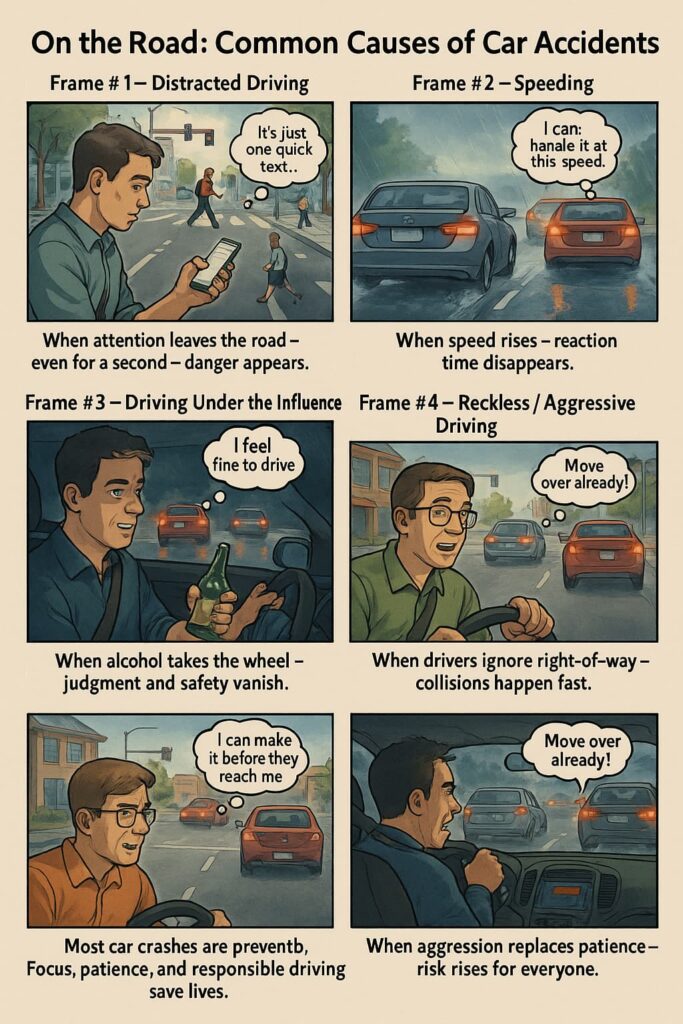
Statistically, most car accidents result from predictable — and preventable — behaviors. According to national transportation data, the top causes include:
- Distracted driving: Texting, phone use, adjusting controls, or eating at the wheel.
- Speeding: Reduces reaction time and increases the force of impact.
- Impaired driving: Alcohol, drugs, and even prescription medication affect judgment and coordination.
- Fatigue: Drowsy driving mirrors the effects of intoxication in slowed reflexes.
- Weather conditions: Rain, fog, and ice can make even careful drivers lose control.
- Aggressive or reckless driving: Tailgating, weaving, or road rage incidents often lead to preventable collisions.
Each cause may carry a different legal implication. For example, a texting driver could face civil liability and a citation for distracted driving laws, while a drunk driver could face criminal DUI charges in addition to civil damages.
The Role of Police Reports
After a crash, police are often the first officials on scene. Their reports serve as crucial evidence. These documents typically include:
- The date, time, and location of the collision
- Statements from drivers, passengers, and witnesses
- A diagram of how the accident occurred
- Notes on visible damage or skid marks
- Citations or suspected violations of law
While police reports aren’t final proof of fault, they guide insurance adjusters and lawyers in evaluating claims. They can also highlight inconsistencies in witness statements or physical evidence that later become central in litigation.
Insurance and Compensation
Every state requires drivers to carry a minimum level of auto insurance, but the details vary widely. Typical coverage types include:
- Liability coverage: Pays for injuries and damages the driver causes to others.
- Collision coverage: Pays for damage to the driver’s own vehicle from a crash.
- Comprehensive coverage: Covers non-collision damage such as theft, fire, or vandalism.
- Uninsured/underinsured motorist coverage: Protects against drivers who lack adequate insurance.
- Medical payments or personal injury protection (PIP): Covers medical costs regardless of fault.
When a collision occurs, insurance companies investigate by reviewing statements, photos, and damage assessments. The goal is to assign fault percentages and determine payouts. In comparative fault states, damages may be reduced by the injured person’s own share of responsibility.
Comparative and Contributory Negligence
Not every accident is black and white. In many cases, multiple drivers share blame. Laws about shared fault differ:
- Pure comparative negligence: A driver can recover damages even if 99% at fault, but the recovery is reduced by that percentage.
- Modified comparative negligence: Recovery is barred if the driver is 50% or 51% or more at fault, depending on the state.
- Contributory negligence: In a few jurisdictions, if a driver is even 1% at fault, they cannot recover at all.
These distinctions shape outcomes dramatically. A rear-end collision might appear straightforward, but if the lead driver braked suddenly without reason, both parties could share liability.
Car Accident Investigations
After a crash, investigations combine physical evidence and human testimony. Key steps include:
- Accident reconstruction: Experts analyze skid marks, vehicle positions, and impact angles to model what happened.
- Vehicle “black box” data: Modern cars record speed, braking, and steering data seconds before impact.
- Surveillance and dashcam footage: Increasingly used to verify claims.
- Witness interviews: Corroborate driver statements.
- Medical reports: Connect injuries to the accident and verify timing.
In cartoons, these moments translate into scenes of detectives, scientists, or even “forensic mechanics” piecing together the puzzle — but in reality, it’s a careful process that determines legal accountability.
The Claims and Settlement Process
Most car accident disputes end with insurance settlements, not courtroom trials. The process typically unfolds in these stages:
- Notification: Drivers report the accident to their insurer within days.
- Investigation: Adjusters collect documents, photos, and repair estimates.
- Medical evaluation: Doctors assess injuries and treatment costs.
- Settlement offer: The insurer proposes a payout based on fault and policy limits.
- Negotiation: Parties may dispute the amount or fault determination.
- Litigation (if unresolved): A lawsuit may follow, often ending in mediation or trial.
Settlement values depend on tangible losses (medical bills, lost income, property damage) and intangible ones (pain and suffering). Juries consider both when awarding damages in serious cases.
Special Types of Car Accidents
Certain accident types involve unique laws or responsibilities:
- Commercial vehicle collisions: Trucking companies must comply with federal safety regulations, and their drivers’ logs can be key evidence.
- Rideshare accidents: Liability depends on whether the driver was logged into the app and carrying passengers.
- Government vehicle accidents: Claims against city, state, or federal vehicles often require special notice and shorter deadlines.
- Hit-and-run incidents: Criminal investigations run parallel to insurance claims, and uninsured motorist coverage may apply.
- Pedestrian and bicycle accidents: Right-of-way and visibility issues play central roles.
These cases often appear in cartoons as exaggerated versions of everyday life — a delivery truck barreling through traffic, or a driver distracted by a GPS gone haywire — but they mirror real-world legal complexities.
Common Injuries and Medical Evidence
The human cost of car accidents ranges from mild bruising to life-altering injuries. Frequent outcomes include:
- Whiplash and soft-tissue damage
- Broken bones
- Concussions and traumatic brain injuries
- Spinal cord damage
- Internal bleeding
- Burns or disfigurement
Medical documentation provides the bridge between the crash and the claimed losses. Emergency room records, diagnostic imaging, and rehabilitation notes help establish the extent of injury and prognosis. This evidence can affect both insurance valuations and jury awards.
Technological Impacts on Car Accident Law
Modern technology has transformed how accidents are prevented and analyzed.
- Driver-assist systems: Lane-keeping, adaptive cruise control, and automatic braking reduce collisions but create new liability questions when they fail.
- Event data recorders: Provide objective crash data, much like airplane black boxes.
- Dashcams and surveillance: Offer visual proof of events, replacing conflicting eyewitness memories.
- Self-driving cars: Raise unprecedented legal questions about human oversight, software errors, and product liability.
Cartoons about “smart cars on trial” or “robots behind the wheel” capture this shift toward technological accountability.
Legal Timelines and Statutes of Limitation
Each state sets a time limit — called a statute of limitation — for filing a car accident lawsuit. These deadlines usually range from one to four years. Missing the deadline means losing the right to bring the case entirely.
Other key timelines include:
- Reporting deadlines to insurance carriers (often within 30 days)
- Medical examinations required by PIP or workers’ compensation claims
- Notice periods for claims against government entities
Understanding these limits is critical because evidence fades and witness memories weaken over time.
Economic vs. Non-Economic Losses
Damages from a car accident fall into two broad categories:
- Economic losses: Medical expenses, lost wages, property repairs, and other measurable costs.
- Non-economic losses: Pain, suffering, emotional distress, and loss of enjoyment of life.
In serious cases, courts may also award punitive damages to punish reckless behavior — for example, drunk driving or street racing.
The Courtroom Perspective
If settlement fails, the case proceeds to trial. There, lawyers present evidence, examine witnesses, and reconstruct the event before a jury. The outcome hinges on credibility and proof.
Typical courtroom questions include:
- Did the defendant act as a reasonably careful driver would have?
- Were the plaintiff’s injuries directly caused by the crash?
- How much should the damages be worth?
Cartoon depictions of “traffic court dramas” can simplify these ideas, using humor to show how facts, emotion, and logic collide — just like the vehicles in question.
Preventing Car Accidents
While the legal system addresses what happens after a crash, prevention is the deeper lesson. Research shows that simple habits dramatically cut risk:
- Keep a safe following distance.
- Put phones away while driving.
- Don’t drive when tired or impaired.
- Maintain vehicles regularly — tires, brakes, and lights.
- Obey speed limits and signal lane changes.
Public campaigns and legal penalties reinforce these behaviors, but culture plays a role too. Each cartoon story on Law Cartoon aims to make these lessons memorable through humor and empathy.
Car accident law isn’t just about who pays for repairs — it’s a window into human behavior, responsibility, and risk. Every fender-bender, hit-and-run, or pile-up reveals how laws balance fairness with accountability. By translating these scenarios into cartoons, Law Cartoon captures the real drama behind the wheel — where a split-second decision can turn into a legal case, a lesson in safety, or a story worth retelling.