
Bicycle Accidents
Bicycles occupy a unique place on the road — part vehicle, part vulnerable human. Riders share lanes with cars, buses, and trucks while following rules designed for both safety and fairness. When accidents happen, they reveal how delicate that balance really is.
At Law Cartoon, each bicycle accident scenario we illustrate is rooted in genuine legal issues: right-of-way rules, insurance disputes, municipal liability, and the continuing evolution of traffic law for cyclists.
The Rise of the Modern Cyclist
Over the past decade, cycling has exploded in popularity. Cities across the country have added bike lanes, greenways, and “share the road” initiatives. Yet with more cyclists on the streets, collisions between bicycles and motor vehicles have also increased.
According to national transportation data, tens of thousands of cyclists are injured in crashes each year, with several hundred fatalities annually. Most of these accidents occur in urban areas, during daylight hours, and often at intersections.
Cycling is healthy, eco-friendly, and efficient — but legally, it’s complex. Cyclists are treated as drivers in most states, meaning they must obey the same traffic laws as cars. At the same time, they are far more exposed to injury, so legal protections have evolved to reflect that imbalance.
How Bicycle Accidents Happen
Bicycle accidents vary widely in cause and severity. Some involve low-speed bumps that lead to scrapes or bent wheels; others involve catastrophic injuries. Common types include:
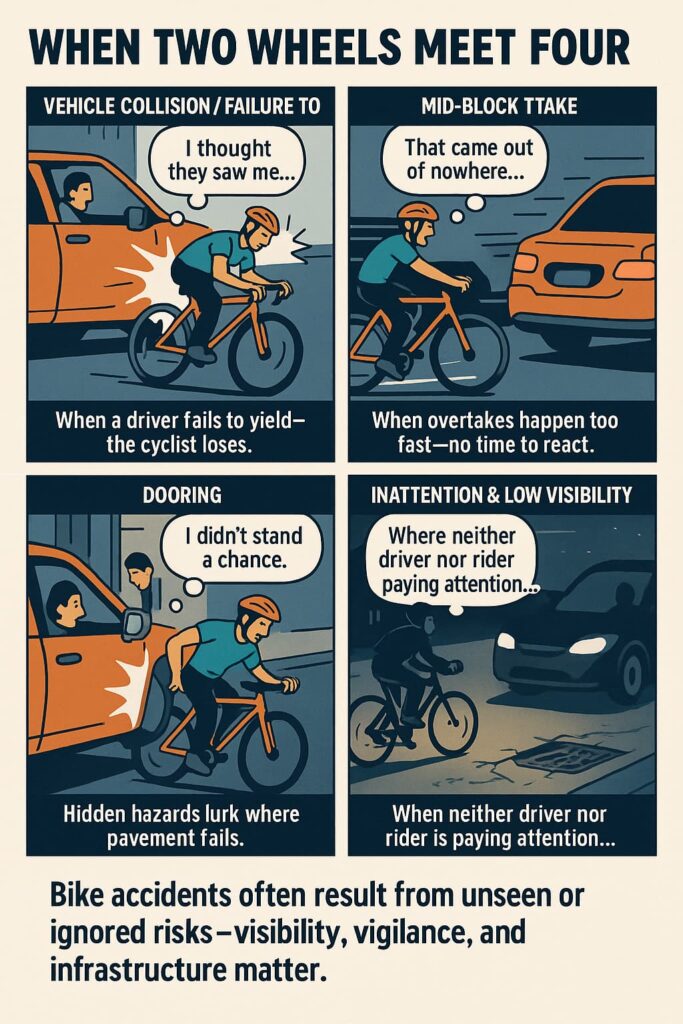
- Dooring: When a parked driver opens a car door into a cyclist’s path.
- Intersection collisions: Where a turning car crosses a cyclist’s lane.
- Rear-end impacts: When a driver misjudges distance or fails to notice a bike.
- Side-swipes: Often caused by unsafe passing in narrow lanes.
- Right-hook and left-cross crashes: Turning vehicles cutting off oncoming cyclists.
- Pothole or road defect accidents: Where the city or maintenance authority may be liable.
- Collisions with pedestrians or other cyclists.
Each type raises a slightly different set of legal questions: Was someone negligent? Did a local ordinance or traffic signal play a role? Were safety standards met for signage, lane markings, or road design?
The Law’s View: Cyclists as “Vehicles”
In most jurisdictions, bicycles are considered “vehicles” under traffic law. Cyclists must ride with the flow of traffic, obey signals, yield where required, and use lights or reflectors at night. In turn, motorists must treat bicycles as lawful users of the road.
That means:
- Drivers must leave a safe passing distance (often three feet or more).
- Cyclists have the right to use a full lane when it’s unsafe to share.
- Motorists must check mirrors and blind spots before opening doors or turning.
- Both parties must exercise reasonable care to prevent foreseeable harm.
Violations of these rules — whether a driver speeding through a bike lane or a cyclist running a red light — can establish negligence if an accident occurs.
Negligence and Fault in Bicycle Accidents
Negligence is the backbone of civil liability in bicycle accident cases. To prove negligence, the injured party must show:
- Duty of care: Drivers and cyclists owe each other a duty to follow traffic laws and act prudently.
- Breach: One party failed to uphold that duty (for instance, texting while driving or ignoring a stop sign).
- Causation: That breach directly caused the accident.
- Damages: The cyclist suffered measurable losses — injuries, medical bills, or property damage.
Both sides can share fault. A driver may have turned too quickly, but a cyclist might have been riding without lights at dusk. In comparative negligence states, a court assigns percentages of fault, reducing compensation accordingly. In contributory negligence states, even a small share of fault can bar recovery altogether.
Common Causes Behind the Handlebars
Beyond the obvious — distracted or reckless driving — several environmental and human factors contribute to bicycle crashes:
- Poor road conditions: Cracked pavement, debris, or missing signage.
- Insufficient lighting: Many accidents occur at dawn or dusk.
- Inadequate infrastructure: Lack of protected bike lanes or clear markings.
- Impaired operation: Alcohol, fatigue, or medication affecting judgment.
- Speed differentials: The challenge of sharing roads designed for faster vehicles.
- Inexperience: New cyclists or drivers unfamiliar with bike laws.
When cartoons exaggerate these scenarios — a biker dodging potholes like landmines or a driver juggling a coffee and a phone — they reflect real, everyday risks that courts later dissect in fine legal detail.
Bicycle Accident Injuries
Even at low speeds, a bicycle crash can cause severe trauma. Unlike car occupants, cyclists have no protective shell. Helmets reduce head injury risk but can’t prevent all harm.
Common injuries include:
- Traumatic brain injuries and concussions
- Broken collarbones, wrists, and ribs
- Dental or facial fractures
- Road rash and deep lacerations
- Spinal injuries and paralysis
- Internal bleeding or organ damage
Medical records become essential legal evidence. They document both immediate harm and long-term effects such as chronic pain or lost mobility. In serious cases, life-care planners estimate the future cost of rehabilitation or adaptive equipment.
The Role of Police Reports and Witnesses
When a bicycle accident occurs, calling the police is critical — even if injuries seem minor. The responding officer’s report creates an official record of what happened. It typically includes:
- The exact location and time of the incident
- Statements from the cyclist, driver, and witnesses
- Citations issued for traffic violations
- A diagram or description of vehicle positions
- Environmental notes (lighting, weather, visibility)
Witness statements often make or break these cases. Unlike car collisions, which may leave physical skid marks or debris, bicycle crashes rely heavily on human observation and testimony.
Insurance and Compensation
One of the most misunderstood aspects of bicycle accidents is how insurance coverage applies.
Depending on the circumstances, several policies may come into play:
- Driver’s auto liability insurance: Covers cyclist injuries if the driver is at fault.
- Cyclist’s homeowner or renter insurance: May apply if the cyclist injures someone else.
- Uninsured/underinsured motorist coverage: Helps when a driver has no insurance or flees the scene.
- Personal injury protection (PIP): In no-fault states, cyclists can use their own PIP benefits for medical expenses.
- Health insurance: Often steps in for uncovered medical costs.
Determining which policy applies can be complex — especially when both parties are moving vehicles under the law.
Government and Roadway Liability
Sometimes, no driver is to blame. If a cyclist crashes because of a dangerous road condition, the responsible government entity might face liability. These are called premises or roadway defect claims.
Examples include:
- Poorly maintained potholes or uneven surfaces
- Faded or missing bike lane markings
- Malfunctioning traffic signals
- Untrimmed vegetation obscuring visibility
Claims against municipalities follow special rules: shorter notice deadlines, strict filing procedures, and often limited compensation. In cartoons, these situations become exaggerated — a cyclist launching from a pothole crater or meeting a stop sign hidden by jungle-like trees — but they mirror real negligence cases against public agencies.
Product Liability and Defective Equipment
Not every crash involves another vehicle or poor infrastructure. Sometimes, the bicycle itself is the culprit.
Defective frames, faulty brakes, or malfunctioning e-bike batteries can cause sudden loss of control. In these cases, the manufacturer, distributor, or retailer may be liable under product liability law.
Evidence includes:
- Maintenance records
- Expert mechanical inspections
- Recall notices
- Engineering reports
This area of law overlaps with general consumer safety principles — showing how even personal recreation can intersect with corporate accountability.
The Legal Process After a Crash
When a bicycle accident causes injury or significant damage, the legal process often follows a familiar pattern:
- Initial report and medical care – Immediate treatment and police involvement.
- Claim notification – Filing with the relevant insurance companies.
- Investigation – Gathering evidence, photos, GPS data, and medical documentation.
- Negotiation – Adjusters assess liability and offer settlements.
- Litigation – If disputes remain, lawsuits may be filed.
- Trial or resolution – A jury or judge determines responsibility and damages.
Most cases settle before reaching court. But even cartoonish depictions of courtroom drama — a cyclist in a sling facing a suited driver — capture the underlying reality: determining who must pay for harm done.
Comparative Fault in Cycling Cases
Because bicycles move differently from cars, fault determinations can be subtle. For example:
- A driver makes a right turn without checking for bikes — clear negligence.
- A cyclist runs a stop sign — shared fault.
- A car passes too close, forcing the cyclist into traffic — driver likely at fault.
- A cyclist rides at night without lights — reduced visibility may assign partial blame.
States use either pure comparative negligence (damages reduced by the cyclist’s share of fault) or modified comparative negligence (no recovery if the cyclist is 50–51% at fault). Only a few still follow contributory negligence, which completely bars recovery for any fault by the cyclist.
Evidence in Bicycle Accident Cases
Technology now plays a major role in proving what happened:
- Helmet cameras and dashcams: Provide real-time footage.
- GPS trackers and fitness apps: Record speed, route, and time.
- Vehicle “black boxes”: Reveal braking and steering inputs before impact.
- Traffic cameras and surveillance footage: Offer objective visual proof.
- Digital accident reconstruction: Engineers model crashes using physics data.
In cartoons, these tools can be reimagined as detectives in lab coats decoding gadgets — but in real cases, they often mean the difference between speculation and proof.
Common Defenses in Bicycle Accident Cases
Drivers or their insurers may raise several defenses, including:
- The cyclist violated a traffic law.
- The accident was unavoidable due to sudden conditions.
- The cyclist’s injuries resulted from not wearing a helmet (in states where adult helmet laws exist).
- The cyclist assumed the risk by riding in a known hazardous area.
Courts evaluate these claims carefully, balancing public policy — promoting cycling — against the principle of personal responsibility.
The Role of City Planning and Public Policy
Beyond individual cases, bicycle accidents highlight the broader question of infrastructure design. Urban planners now study “Vision Zero” policies aimed at eliminating traffic deaths.
Key strategies include:
- Protected bike lanes separated from traffic.
- Improved intersection visibility.
- Dedicated bike signals and signage.
- Lower speed limits in high-traffic corridors.
- Public education for both drivers and cyclists.
The law evolves with these initiatives. As cities redesign their streets, liability standards and expectations for “reasonable care” shift as well.
Statutes of Limitation and Deadlines
Time limits for bringing bicycle accident claims vary by state, typically ranging from one to three years. Claims against government entities may require notice within just a few months.
Other key deadlines:
- Insurance claim reporting: often within 30 days.
- Medical documentation: needed promptly to link injuries to the crash.
- Product defect claims: sometimes governed by separate warranty or discovery rules.
Failure to meet these deadlines can permanently bar recovery, even if fault is clear.
Economic and Non-Economic Losses
Losses from bicycle accidents fall into two broad categories:
- Economic damages: Medical bills, lost wages, bike repair or replacement, and rehabilitation costs.
- Non-economic damages: Pain, suffering, emotional distress, loss of enjoyment of life.
In cases involving reckless or intentional conduct — for example, road rage or drunk driving — punitive damages may apply to deter future misconduct.
Preventing Bicycle Accidents
Most bicycle accidents are preventable. Safety studies emphasize the following habits:
- Wear helmets and visible clothing.
- Use front and rear lights even during daylight.
- Ride predictably — signal turns and avoid weaving.
- Obey traffic signals.
- Stay alert for opening car doors and turning vehicles.
- Maintain your bike’s brakes and tires.
From a policy standpoint, consistent enforcement of traffic laws for both drivers and cyclists remains the most effective deterrent.
The Cultural Meaning of Bicycle Law
Bicycle law reflects larger social themes — sustainability, equity, and freedom of movement. Cartoons that portray cyclists dodging SUVs or negotiating with police after a crash highlight the tension between old infrastructure and new commuting realities.
Behind every humorous frame is a serious story about how cities adapt to shared mobility and how law defines fairness on the road.
Bicycle accidents blend physics, human behavior, and evolving public policy. They sit at the crossroads of transportation, health, and law. Each case — whether it’s a “dooring” on a quiet street or a high-speed collision downtown — reveals how fragile safety can be when two wheels meet two tons of steel.
Through its cartoons, Law Cartoon aims to make these moments both understandable and memorable, showing that even in the most chaotic intersections, the law is always in motion — striving, like a careful rider, to keep balance.