Pedestrian Accidents: Causes, Consequences, Safety Issues, and What the Data Shows
Pedestrian accidents remain one of the most serious public-safety issues in the United States and around the world. Even as vehicles become safer and cities adopt traffic-calming measures, the number of pedestrians injured and killed each year continues to rise. Understanding how and why these accidents happen, the factors that increase risk, and the legal principles that typically apply can help individuals, families, policymakers, and community members make better decisions and advocate for safer environments.
This guide provides an in-depth look at pedestrian accidents, including common causes, contributing factors, injury patterns, insurance and liability considerations, and national trends.
1. What Counts as a Pedestrian Accident?
A pedestrian accident occurs when an individual on foot is struck by a moving vehicle, bicycle, scooter, or other motorized personal-transport device. This category includes people who are:
-
Walking
-
Running or jogging
-
Using mobility aids (wheelchairs, walkers, crutches)
-
Standing near traffic, such as on sidewalks or shoulders
-
Crossing streets, whether at crosswalks or not
Pedestrian accidents also include “non-traffic” incidents that occur in parking lots, driveways, alleys, and private roads.
2. How Common Are Pedestrian Accidents? National Trends
Recent data shows that pedestrian accidents have been increasing for over a decade. In the U.S.:
-
More than 7,500 pedestrians were killed in 2022, the highest number in 40 years.
-
Over 100,000 pedestrians are injured each year in traffic-related incidents.
-
Pedestrians now account for nearly one in six traffic fatalities nationwide.
Several factors contribute to rising numbers, including larger vehicles, distraction, faster road designs, population growth in urban areas, and higher rates of walking and biking.
Worldwide, the World Health Organization estimates that pedestrians make up about 23% of all road-traffic deaths.
3. Why Pedestrian Accidents Happen: The Most Common Causes
3.1 Driver Inattention and Distracted Driving
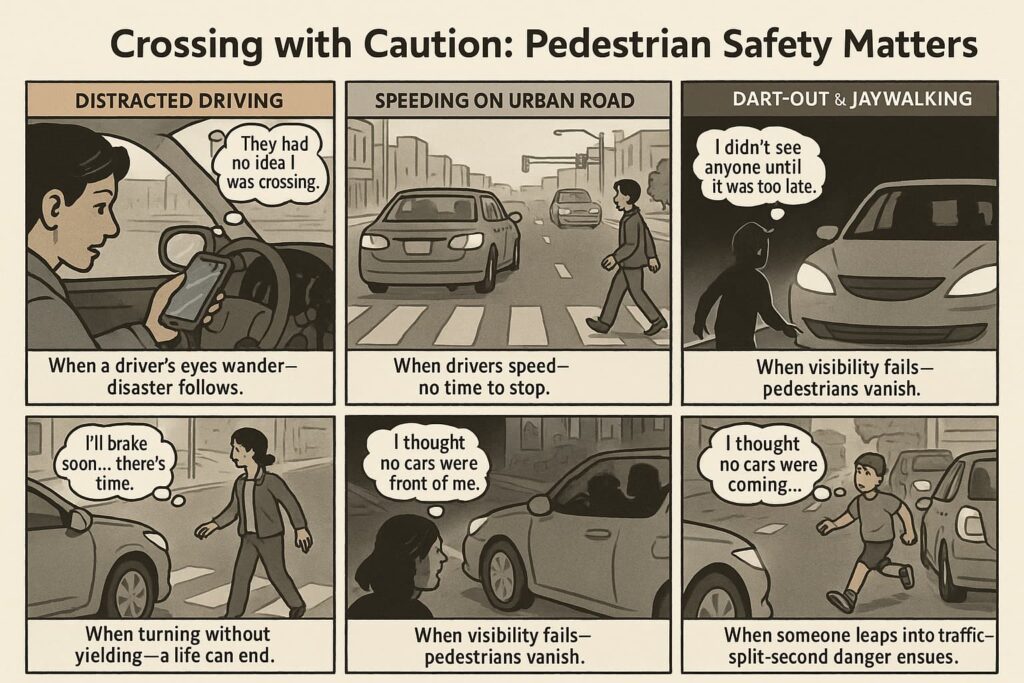
Distraction is one of the primary causes of pedestrian collisions. The most common distractions include:
-
Smartphone use (texting, browsing, GPS input)
-
Talking with passengers
-
In-vehicle displays and infotainment systems
-
Eating or drinking
-
Fatigue
A driver can drift off course, miss a crosswalk signal, or fail to see someone entering a roadway in time to stop.
3.2 Failure to Yield at Crosswalks
In many jurisdictions, drivers are required to stop when a pedestrian is in a marked crosswalk. However, failure to yield is extremely common. Drivers may:
-
Make rolling right turns on red
-
Turn left while focusing on oncoming traffic instead of pedestrians
-
Speed through intersections before the light changes
3.3 Speeding
Speed directly affects both the likelihood of a crash and the severity of injuries. According to studies:
-
A pedestrian struck at 20 mph has a high chance of survival.
-
At 40 mph, the fatality risk increases dramatically.
-
At 50 mph, a survival is far less likely.
Because speeding reduces reaction time, drivers are less able to avoid pedestrians who unexpectedly enter the street.
3.4 Impaired Driving
Alcohol and drug impairment remains a significant factor in pedestrian fatalities. Impairment affects:
-
Reaction times
-
Peripheral vision
-
Decision-making ability
Both impaired drivers and impaired pedestrians are at higher risk.
3.5 Backover and Parking-Lot Accidents
Pedestrian accidents do not only occur on major roadways. A large portion of injuries take place in:
-
Parking lots
-
Residential driveways
-
Commercial loading areas
“Backover” accidents happen when a driver reversing fails to see someone behind the vehicle. Large SUVs and trucks have bigger blind spots, increasing this risk.
3.6 Poor Visibility and Low-Light Conditions
A significant majority of pedestrian fatalities occur after dark. Contributing factors include:
-
Dark clothing
-
Poor street lighting
-
Glare from other vehicles
-
Weather conditions like rain or fog
3.7 Roadway Design
Certain road features increase pedestrian danger, including:
-
Wide, high-speed roads
-
Lack of sidewalks
-
Long distances between crosswalks
-
Intersections without signals
-
Poorly marked pedestrian areas
Streets designed primarily for vehicle flow often place pedestrians at a disadvantage.
4. Common Locations of Pedestrian Accidents
Although pedestrian collisions can occur almost anywhere vehicles and people mix, the highest-risk locations are:
4.1 Intersections
Intersections are the site of roughly one-quarter of pedestrian crashes. Complex traffic patterns, turning vehicles, and limited visibility contribute to higher risk.
4.2 Urban Areas
Cities have higher pedestrian volumes, more mid-block crossings, and greater exposure to cars, buses, and delivery trucks. Over 80% of pedestrian fatalities occur in urban environments.
4.3 Arterial Roads
These are major roads designed for high traffic flow, often with multiple lanes and higher speeds. Pedestrians may cross these roads while shopping, commuting, or accessing bus stops.
4.4 School Zones
Despite lower speed limits, school zones see frequent pedestrian activity at certain hours, increasing the chance of incidents involving children.
4.5 Parking Lots
Pedestrian accidents in parking lots often involve slow-moving vehicles, but can still cause fractures, back injuries, and head trauma.
5. Who Is Most at Risk? Demographic Patterns
Certain groups experience higher rates of pedestrian injury or death.
5.1 Older Adults
Individuals aged 65+ represent a disproportionate share of pedestrian fatalities. Contributing factors include:
-
Reduced mobility
-
Slower walking speed
-
Vision or hearing impairments
5.2 Children
Children are more likely to be injured in:
-
School zones
-
Driveways
-
Residential streets
Young children may dart into the street unexpectedly, and their smaller size makes them harder for drivers to see.
5.3 Low-Income Communities
Neighborhoods without adequate sidewalks, lighting, and crosswalks experience higher accident rates.
5.4 Pedestrians at Night
Most fatal crashes occur between 6 PM and midnight, especially in winter months when daylight hours are shorter.
6. Types of Injuries in Pedestrian Accidents
Because pedestrians have no protection against a moving vehicle, injuries are often severe.
6.1 Head Injuries
Traumatic brain injuries (TBI) are among the most common outcomes, ranging from concussions to severe brain damage.
6.2 Fractures
Legs, hips, ribs, and arms are frequently fractured upon impact.
6.3 Spinal Injuries
These can include herniated discs, fractured vertebrae, and in severe cases, paralysis.
6.4 Internal Organ Damage
Blunt-force trauma can injure the lungs, kidneys, liver, and spleen.
6.5 Soft Tissue Injuries
Bruises, muscle tears, tendon injuries, and sprains are common even in lower-speed impacts.
6.6 Fatal Injuries
A significant percentage of pedestrian accidents lead to death, especially those involving high-speed impacts or larger vehicles.
7. Vehicle Types and Their Impact on Injury Severity
Not all vehicles pose the same level of risk.
7.1 SUVs and Trucks
Larger vehicles tend to cause more severe injuries because:
-
Their front ends strike higher on the body
-
Their weight generates more force
-
Their blind spots are larger
The rise in SUV ownership is widely believed to be a factor in increasing pedestrian fatalities.
7.2 Passenger Cars
Smaller sedans typically strike the lower extremities first. Injuries may be less catastrophic than SUV impacts but are still significant.
7.3 Electric Vehicles
Quiet engines make EVs harder for pedestrians to detect, especially at low speeds.
7.4 Commercial Vehicles
Buses, delivery trucks, and semi-trucks pose elevated risks due to weight, size, and wider turning radii.
8. Legal Considerations in Pedestrian Accidents (General Principles)
This section explains common legal frameworks without offering legal advice or promoting legal services.
8.1 Right-of-Way Rules
Most jurisdictions outline specific right-of-way rules such as:
-
Vehicles must stop for pedestrians in marked crosswalks.
-
Drivers must yield when turning left or right.
-
Pedestrians must follow traffic signals.
-
Jaywalking rules vary, but pedestrians are still protected from unreasonable driver behavior.
Both drivers and pedestrians can share responsibility depending on circumstances.
8.2 Negligence Concepts
Pedestrian accidents often involve questions of negligence, which generally requires showing:
-
Duty of Care – Drivers must operate vehicles safely.
-
Breach – A driver acts unsafely (speeding, texting, running a red light).
-
Causation – The breach causes the accident.
-
Damages – The pedestrian suffers injury or harm.
These are foundational principles found in many legal systems.
8.3 Comparative or Contributory Fault
States vary on how they treat fault:
-
Comparative fault: responsibility may be shared between parties.
-
Contributory fault: in some jurisdictions, if the pedestrian is even slightly at fault, recovery may be limited.
This is one of the biggest variations in state-level pedestrian laws.
8.4 Insurance Coverage Considerations
In many pedestrian accidents, insurance policies that may come into play include:
-
Driver’s auto-liability insurance
-
Uninsured/underinsured motorist coverage
-
Personal injury protection (PIP) where available
-
Medical payments coverage
Pedestrians may be covered under their own policies even when not driving.
8.5 Hit-and-Run Issues
Hit-and-run pedestrian accidents remain a serious problem. Insurance, police investigations, and traffic cameras often play roles in identifying drivers when they flee.
9. Environmental and Behavioral Factors That Increase Risk
9.1 Lack of Infrastructure
Pedestrian risks rise when communities lack:
-
Sidewalks
-
Crosswalks
-
Pedestrian signals
-
Street lighting
9.2 Distracted Walking
Pedestrians using smartphones may:
-
Enter intersections without looking
-
Misjudge traffic signals
-
Fail to observe turning vehicles
9.3 Weather Conditions
Rain, snow, and fog reduce visibility and traction for both pedestrians and drivers.
9.4 Traffic Density
Heavily trafficked commercial districts have a higher rate of pedestrian conflicts.
9.5 Alcohol Use by Pedestrians
Although less discussed, alcohol impairment among pedestrians plays a role in many nighttime incidents.
10. Preventing Pedestrian Accidents: What Works and What Doesn’t
10.1 Infrastructure and Urban-Planning Improvements
Cities that implement the following measures often see meaningful reductions:
-
Protected crosswalks with pedestrian islands
-
Road diets that reduce lane width or the number of lanes
-
Speed bumps and raised intersections
-
Better lighting
-
Sidewalk improvements
-
Mid-block crossings near high-traffic pedestrian zones
These changes slow vehicles and increase pedestrian visibility.
10.2 Vehicle-Safety Technologies
Modern vehicles can reduce crash risk through:
-
Automatic emergency braking (AEB)
-
Pedestrian-detection sensors
-
Blind-spot alerts
-
Rear-view and 360-degree cameras
However, these systems are not foolproof and do not replace driver attention.
10.3 Education and Awareness
Public-safety campaigns emphasize:
-
Avoiding distraction
-
Yielding to pedestrians
-
Following crossing signals
-
Increasing nighttime visibility
10.4 Enforcement Measures
Law enforcement often targets:
-
Speeding
-
Failure to yield
-
Impaired driving
High-visibility enforcement campaigns have been shown to reduce pedestrian injuries.
11. After a Pedestrian Accident: Typical Processes and Considerations
Again, this is presented for informational purposes only.
11.1 Medical Evaluation
Even seemingly minor incidents can cause internal injuries or delayed-onset symptoms. Common steps include:
-
Emergency-room evaluation
-
Imaging (X-rays, CT scans, MRIs)
-
Follow-up care
11.2 Police Reports
Police reports document:
-
Where the accident occurred
-
Driver and pedestrian behavior
-
Witness statements
-
Weather and road conditions
These reports often play an important role in later evaluations.
11.3 Insurance Processes
Insurance adjusters may investigate:
-
Fault
-
The extent of injuries
-
Medical treatment
Multiple insurance policies may be involved depending on the circumstances.
11.4 Accident Reconstruction
In severe or complex cases, accident reconstruction specialists may examine:
-
Vehicle speed
-
Impact angles
-
Braking distance
-
Visibility
-
Road layout
This helps determine how and why the accident happened.
12. Long-Term Impacts of Pedestrian Accidents
The effects of a pedestrian accident extend far beyond the initial injury.
12.1 Physical Consequences
Some individuals experience long-term or permanent disabilities, including:
-
Chronic pain
-
Loss of mobility
-
Neurological issues
-
Vision or hearing problems
12.2 Psychological Effects
Pedestrian accidents may also lead to:
-
Anxiety
-
Depression
-
Sleep disturbances
-
PTSD‐like symptoms
Fear of walking or crossing streets is common.
12.3 Economic Impact
Accidents may result in:
-
Medical expenses
-
Rehabilitation costs
-
Lost work time
-
Long-term loss of earning capacity
13. Pedestrian Safety Tips
Although not all accidents are preventable, pedestrians can reduce risk by:
-
Using crosswalks whenever possible
-
Making eye contact with drivers
-
Wearing bright or reflective clothing at night
-
Avoiding distraction while crossing
-
Waiting for complete traffic stops before entering intersections
These steps are particularly important in high-traffic environments.
14. Community and Policy Approaches
Communities can take steps to improve pedestrian safety through:
14.1 Vision Zero Programs
These programs aim to eliminate all traffic fatalities through engineering, enforcement, and education.
14.2 Safe-Routes-to-School Initiatives
These programs encourage safe pedestrian pathways for children.
14.3 Local Legislation
Cities may enact laws that target:
-
Speed limits
-
Sidewalk-maintenance requirements
-
“No right turn on red” restrictions
-
Crosswalk enforcement
14.4 Data-Driven Planning
Urban planners use crash-mapping tools to identify high-risk locations and prioritize improvements.
Pedestrian accidents have become a growing public-safety concern as roadways become busier and more complex. Understanding the factors that contribute to these incidents can help reduce risk for individuals, families, and communities. Although accidents cannot be eliminated entirely, improvements in roadway design, driver behavior, pedestrian awareness, and vehicle technology can significantly reduce injury and fatality rates.
This comprehensive overview highlights the scope of the problem, the most common causes, the types of injuries involved, legal concepts typically associated with these incidents, and strategies for prevention. As communities continue to evolve and transportation habits change, ongoing attention to pedestrian safety remains essential for creating safer environments for everyone.